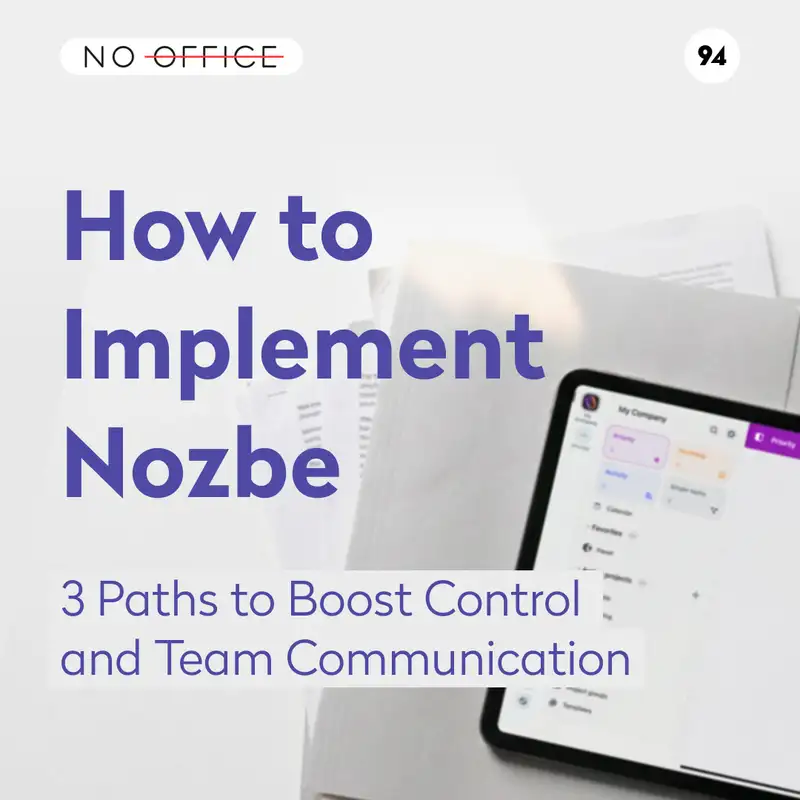
How to Implement Nozbe: 3 Paths to Boost Control and Team Communication
Hello. Whether you like to click around and explore apps on your own, or you prefer getting
a ready-made, tailored system, this episode is for you. Today, we're breaking down the
three paths to getting started with a productivity tool like Nozbe, and exactly like Nozbe,
that will instantly boost your team's productivity. There is no right or wrong answer. All three
paths are great. The question is, which one of them is for you? So, which path will you
choose? Let's dive in and let us know in the comments below. And for me to digest this
and to go through all these three paths, there is Magda. Hello, Magda.
Hello, everyone.
Hello, Magda.
This is Magda.
This is No Office Podcast number 94, and here we are discussing ways of introducing and
implementing a new tool. It's always a big challenge. It's always a change, and it depends
on several conditions to me. For sure, it's the organization size. If the organization is huge,
the implementation of the new tool.
The implementation of the new tool will be much more difficult. Also, it depends on tool complexity. So, if we are going to talk about Nozbe, Nozbe is pretty simple. So, this is our cone.
It is our sales pitch. Nozbe is simple to use, easy to use. It has lots of advanced features once you start digging into it. But initially, the whole idea is that Nozbe is very simple and easy to use. There is this straightforward structure of
projects, tasks, and details, and comments. So, this is it. But.
Yeah. But also, there are things like how the new tool, no matter if it's simple or complex, will influence our business processes. What will be the impact? If there will be a lot of changes, a lot of updates necessary, or it will go to the next level.
Yeah.
And the problem is, although we should be extremely Health
Hmm.
Yeah.
their old habits no matter if they are good habits or bad habits and they won't let you and
they will you know they will get stiff and they will maybe not even consciously but they will
somehow spoil the the development yeah i mean we've had you know over the last 19 years that
we've been running nosby we have had many customers and we have you know usually smaller
companies small companies busy professionals solopreneurs but we also have some bigger
companies and sometimes it goes like this that you know the the leader the boss imposes
the tool on them and then they are not receptive or they are receptive you know it depends but
sometimes it goes the other way around the leader chooses nosby implements nosby and later he thinks
like ah maybe we should try something else and then the the the people in the team are like no
no no we already got the hang of it
we like it we want to use it no no you will not take it away from us so it's you know we've seen
it all basically yeah that's true um and apart like along with those conditions that i uh that
i listed there is also the the way we implement and uh apart from the kind of tools that we will
show you and the methods there are kind of approaches that leaders managers
companies can take and one of the approach is the crazy one it's called big bang and that means that
we just all users we start using in the same tool at the same time we are all in it we are
talking about it on the you know corridors in the open space this is our main topic everyone is
either happy or unhappy but this is the thing that's now going on in our company
uh there is another approach
calmer just divided into phases and these phases can be um you know it's like which parts of the
company starts to be put into a tool or which departments which groups of people go first
and also there's i think something that is called like pilot implementation
and only selected teams for example a manager
and his assistant and maybe one more person they are starting off and slowly slowly they're adding
up more employees so whatever you choose it's okay it's it just has to be everyone should be involved
yes i mean this is why for example we've changed a little bit the business model from
from the nozbe classic to the new nozbe that will allow not only three active projects but
also three people on the team so we we thought about you know the
situation where you your business partner and maybe your assistant you want to start first
start using us before free you know with the three first three projects and then you start using it
you're like ah we like it and then you upgrade and then you invite some other people and i'm
showing this precisely how it works um on the main nozbe website if you go to nozbe.com you can see
the my video of starting nozbe in five minutes or less and then with the timer you know with stopwatch
Basically, I show you how to sign up for Nozbe, get your first projects, get your first tasks, invite your first people and start working together.
So this is like the smallest approach, the easiest approach that you don't pay anything.
You go with the free plan for a few moments to start with your team and then you upgrade and you go with the whole team.
Mm-hmm. Yeah. So this is kind of the beginning of what we want to tell you.
This is the path number one. Path number one is just you, you decide to do it by yourself.
It's a DIY implementation.
Yeah. It's this moment where, like, this is like the majority of our customers.
Majority of our customers go to Nozbe.com, they've been referred to it.
Somebody mentioned Nozbe.
Or, you know, or they've seen an ad or whatever and or they've seen me showing off in some podcast or something and they're like, ah, let's see what Michael is up to.
And they go to Nozbe.com and they sign up by themselves and they discover the app by themselves.
Maybe they watch the five minute video I mentioned.
Maybe they watch a video tutorial.
Maybe they go also to our help page.
But basically from Nozbe.com, they sign up on their own, they figure it out on their own, and then they figure out also.
How to start.
Kind of, you know, setting up Nozbe for their business, you know, for their processes, for everything.
And this is good for tinkerers, for people who just prefer to do it on their pace, who are not in a rush to set up the system, who don't need, you know, quick implementation or quick or ready-made solutions.
They want to, you know, try it themselves.
And it's great.
Yet, I would still advise.
I would still advise you that even though you're this kind of person, you like to, you know, set it up yourself and tinker by yourself, I would still advise you after a few moments with Nozbe, setting it up and, you know, trying to configure it for yourself and for your team or for your company, then really reach out to Nozbe.com slash demo to book a demo with Magda.
Just as an additional consult.
What do you think?
Yeah, I think in this approach, you should be pretty sure of your team.
That they are ready and that they actually won't really hindrance your ideas and spoil everything and have this kind of rebellion in there, in themselves.
But yeah, once you created your account, once you invited the people who you want to start off with, it's great if you schedule a consult with me.
Because.
I can show you the tool from my expertise and from the way, from the point of view of me talking a lot with different companies and various organizations.
It's great if you schedule the consult once you visited the application a little bit.
Like you maybe.
Set it up a little bit for yourself.
Set it up, yes.
But also clicked and maybe you're also.
Your employees, they try the project, they already know what's the task, they already more or less are aware of what are the details of the task.
It's much more practical because if I mentioned some words like project, like tag, and then they don't really know what it means, the meeting won't be so productive and efficient.
So it's better to schedule a call with me once you more or less know how to navigate through the application.
Because it's great to use me to set up the first structure, to figure out together what should be a project in your company, what could be, what tags you could create to boost your productivity in a team.
I can also show you already some.
Some first steps to kind of, to templates, to automations, to integrations.
So I think it's better to use me for, for this second step after you do the first step yourself and get to know the application.
I'm always, whenever I'm talking about your demo sessions with customers, I'm always telling them that this kind of demo session is for them to tell you how they work, to tell you how they, you know, how they.
How they see such a tool in their lives and in their professional lives.
So above all, and you can translate from their language to Nozbe language.
So in that sense that when you say, you know, we need to set up this project for this client to, you know, for this and that, and you already see, okay, so you, so this would be a template.
This would be a section.
This would be a project.
You can already, you know, translate what they're saying to Nozbe language.
Because you've been through that before many, many times with the customers, so you know what they mean.
And also, yeah, the, the vocabulary we had to use designing our UX, we had to choose some words and sometimes these words are not, not so obvious when we say project, some people associate this word to some corporate level projects, complicated procedures.
And then they say, why, why would you do that?
Why would I need projects if, if I work in a, I don't know, in finance or in, in some technical support, we don't do any projects.
So then I just want to make sure that everyone on a team is aware that the project doesn't have to be the common stereotypical project.
It might be just a folder, a container for tasks, which are somehow related and which can lead you to achieving a goal or to organize.
Some, uh, sector, some, uh, aspect of your, uh, business is the same with a task.
Yeah.
Sometimes people, it's what Michael always says that, that leaders, they, they feel awkward by letting their employees creating tasks for them, delegating something for them.
Yeah.
A task is not something that it's not an order.
Yeah.
It can be a query.
It can be just, uh, some.
A concept.
Referral material, uh, that you put in a project as a task for future reference.
It can be.
Inquiry for feedback.
Yeah.
It can be the, please boss, give me your feedback.
It's, it's kind of conversation.
It's just the structure of work, the vehicle for work.
It's, it's not something related to hierarchy or, or yeah.
So, so also that's, that's the deal.
And that's, uh, that.
What you could use me for, even though you go for DIY, uh, NOSB implementation.
Yeah.
Uh, yeah, because there is like the, this, uh, um, sometimes people think that the words we chose like project, task and comment are, um, are literally these things and these things only.
And projects can be, as you mentioned, the list, you know, a container, like one of the things I mentioned in the five minute video is.
I create a project called marketing, which is not a project that will end ever, because if you are doing marketing, there will be always tasks in project marketing because marketing is not a project.
It's more like a, um, you know, a folder for tasks related to marketing, you know, um, uh, it's more like a folder.
Exactly.
So task is the same, as you said, mentioned for feedback or, or comment can be note or journal, basically, you know, we use comments also as journal.
Like when I do something, I work on something.
I write.
I add the comments to myself.
So I already did this.
I'm working on this and I've, I stopped at that.
And then maybe next time I'll focus on that part.
And then I save it as a comment and probably this comment will not be read by anyone else, but just by me.
But when I come back to this task later, I will have read this comment and I will like, okay, okay.
So I stopped there.
I can continue.
Right.
So a comment can be a journal, a note, um, and, and, and much more.
So that's why, um, uh, you can translate this to people.
When, when they sign up for a demo, so they can understand that, that Nozbe being so simple and using these simple words like project task and comment is very versatile and very flexible and can accommodate just like, you know, just like we have tags, which can be used for so many things.
So it's like, it's a very versatile system, very flexible system to, to, to, uh, to many businesses.
And that's why it's our curse and our blessing that we have customers from all these industries using.
Nozbe on one hand, it's a curse because we cannot sell to one industry.
You know, Nozbe is just for lawyers and nobody else.
Um, because it follows the law nomenclature, you know, no, you know, for words and whatever.
No, no.
Nozbe is for everyone because we have, uh, you know, uh, agencies, we have, um, uh, marketing and this, we have, um, uh, uh, uh, real estate, restaurants, doctors, like, um, universities.
We have like everyone using Nozbe because they can.
Accommodate this, they can accommodate this simple structure to their very complex system and making this complex again, system, uh, and making a complex system simple as it's one of our core benefits of Nozbe, making a complex simple system, simple, simplifies the system and simplifies the execution.
Yeah, I think Nozbe can be some kind of like scaffolding for, for, for your workload.
Yes.
We, we just give you those projects.
So.
So that you can put the whole, the flow that's like, it's like a river and it's crazy and chaotic just to put them in, in folders and containers.
Yes, we don't, Nozbe doesn't influence the, I don't know your work structure, your maybe structure.
Yes, but it doesn't spoil anything.
It just helps.
It just supports.
And as I said, it's kind of scaffolding for, for, for, for the whole workload.
And also it's very.
Important if you go for your own, um, to remember about the, uh, social agreement that is, uh, really necessary, uh, when you introduce a new tool and when you introduce a change in your, um, business processes, because, um, along with a tool, you have to make some rules how to use this tool.
And, um, it's great if yes.
Yes, along with Nozbe account, uh, accounts and, and projects, you tell people how we are going to work with it.
Yes.
That, uh, what are projects, what we are going to treat as project, who can delegate, uh, tasks to whom, uh, what about deadlines, uh, how we should write comments, uh, when to write a comment, um, when to mention someone.
That these are the four or five.
Important points, uh, that, that should be tackled as well, along with introducing a new system.
Yes.
Uh, you know, one of the things, uh, from, from, from me, which are born would always repeat to the leaders.
Once you start using Nozbe, stop using email at all and WhatsApp and all these communicators, like all other, yes.
Do a lot of, help everyone, you know, to reach out, you have to create a task for me or, or, or mention me in a task or.
Send me a message through Nozbe, because it's right to work.
That's it.
Yes.
From our, from our expertise, this is the, the most, uh, effective way.
Just give Nozbe or other tool a chance by letting off, letting, uh, go other, uh, messengers, uh, chats, other tools that you used to, um, use before for communication.
Mm-hmm.
Just dive deep and, and let Nozbe, um, be your main, uh, core tool, and then you see.
Simply, just simply, you know, Nozbe is exclusive for now and that's it.
And we use, and, and if somebody, somebody sends you a message, uh, through different channels, you tell them, uh, please create task for me with this, um, or please message, please copy and paste this message to Nozbe.
And that's it.
So this way, uh, they will learn that next time they should do it like this.
Um, I remember it, it, it took me a, a, a while, uh, when, um, when I hired my, uh, my father as our CFO, as our financial officer, that he was used to, you know, messaging me.
And I was like, uh, and then he was, he would message me, Michael, but you haven't done that for me.
And I'm like, no, I haven't because there was no task about this.
And he was like, oh man.
So he was like, I was, I was making it his fault.
Because he wouldn't put it in the task.
And I was like, if it's not there, I'm not going to do it.
Cause I, I, I do tasks in Nozbe.
I, I, you know, I give you feedback in Nozbe.
So he learned it the hard way, uh, but he learned it.
And now he knows.
Poor Mr. Valdemar.
Yes.
Yes.
But now he's the best Nozbe user.
He's so consistent.
He has those, he follows the rules.
Yes.
If he replies, he always delegates back the, back, uh, the task, uh, just collaborating with him in Nozbe is perfect.
Exactly.
He never forgets any of the rules.
Exactly.
Of the good Nozbe communication.
Good.
Exactly.
Good Nozbe citizen.
Um, yes.
So again, this was the first path.
This is the path of DIY.
DIY.
DIY.
So you set up your own account.
You invite your first people to Nozbe.
You discovered yourself.
You, um, set it up yourself according to your business needs.
You have to do it.
You, you are the tinkerer.
You have the time to do it.
Uh, it takes time to figure it out.
Uh, also you, you might, in that case, you know, after a while, schedule a demo with Magda to really make sure that you're doing it right.
Um, but this is.
Yes, I'm really ready to support you and, and you can, as I said, you can use me.
Yeah, the, the downside of this, uh, of this path is the way that you don't have this someone.
Um, above you who will control you, who will stop you from, uh, pushing it back from postponing, from letting go because it's easier.
If you, if you are doing it yourself, you say, okay, this time I will send her an email or, okay, I will accept that they now have a meeting about it instead of documented, documented in, in Nozbe.
The, the funny thing is that, uh, also, you know, we have customers who have paid for Nozbe, who have, you know.
Paid for the, uh, for the, um, subscription, uh, even for, you know, for the yearly one and they are postponing using it.
So they're like, don't use it the first month, the second month, third month.
And, uh, we get, you know, sometimes we get their email and we ask them, you know, how is it, how are things going?
They're not moving forward yet.
And many people always tell me, oh, Michael, you should be so lucky.
You have people paying you and not using your tool.
That's great.
I'm like, that's not great.
I didn't build this tool.
My heart breaks.
Exactly.
My heart breaks.
I want them to use it.
You know, I, I, I'm not here in, for their money.
I want to help them get organized and I know they will get organized better when using Nozbe.
So I'm also heartbroken when somebody is paying for my tool and not using it.
It's the same about me.
We, when during the, the, um, our consult, someone is really excited and they are okay from tomorrow on, I will start doing it.
I will invite my first employees.
They are so excited and they get the subscription for a month.
Or for a year.
And then I observe, I try to follow how they are doing and I see that this flame is just getting smaller and smaller.
And after three days, there is no, any, uh, movement in their account.
And it's so sad because they were so excited.
They just probably, they needed someone to lead them, to help them, to support them in introducing change in their team.
Because I know how hard it is to be this, this leader who will go first and again.
Against people complaining and being angry with them.
So probably that's the way for path number two or even three.
Yes.
So before we move on that, I just want to do a disclaimer.
So we, we take data privacy very, very seriously at Nozbe.
We have the GDPR agreement with all of our customers.
So when Magda says that she looks at the movement in an account, she has the metrics to know if something is going on in the account.
We don't, you know, monitor the details of their accounts.
We don't have access to it.
We don't have access to that.
And we limit access to that only, you know, for situations where we need, like, you know,
and then we ask for the access to our clients.
But we do have metrics to see if there is some movement, if there is something happening.
Because this way we can, you know, as Magda said, we can do a follow-up to see if things are going or if things are not going, you know.
So in that sense, we have this very, very basic metrics to make sure that we know what's going on.
All right.
So now we'll talk about the path number two and three, which are very exciting.
But before we do that, let's take a break to listen to somebody talk about our tool, how great it is and how great it works for them.
When we've been around for about 10 years, our business has, and we've been using Nozbe for about eight of those.
And as we grew, we kind of got to the point where I just couldn't remember everything anymore.
I'm pretty organized.
I would just kind of keep everything in my head and with post-it notes and things like that.
And it just got to be too much.
And so I started looking around for some sort of project management software that could help me have a set up really trusted system.
But really, I just wanted a system where I could know that I had everything in there.
I wasn't going to forget anything.
I wasn't going to drop any balls for clients or miss deadlines.
All right.
So let's talk about path number two.
Path number two.
And path number two is something new, right, Magda?
So, yeah.
So you tell it because it's your story to tell.
It's our new idea because we thought there is a too big space between path number one and path number three.
So we wanted to make it.
It's easier for people who are afraid to do it alone, but also who are not ready for like external paid professional consultant.
Path number two is our onboarding.
It's probably four or five meetings.
Probably I would have with you as a leader or maybe a leader plus the managers of some departments or maybe with the whole team.
If a team is not.
Too big.
We will first try to understand your needs and see how you your company or organization is doing, where you have some issues.
What's the hindrance?
What is the bottlenecks?
We will just study what's wrong and what's nice in your in your workflow.
That's the first meeting.
After.
This the second stage is the trying to design the first version of your system.
That's when, as we said before, as Michael called it, I will translate will like together.
We'll try to translate your reality into Nozbe reality and design the first scaffolding, the first structure, your first project to see what should be projects, what should be tags.
How we can.
Group projects, how you can personalize your sidebar with project groups and and also to try to think up this social agreement that that will be good for your organization, then it will be time for training the whole team once we have the structure once we have the projects ready.
We can.
We can train the team because my main like what I learned from from the meetings with clients is that's really not good to let new users, your employees, your your teammates to an empty application.
I don't know if you know this man internet man when John Travolta is in empty space and he's like turning around and looking for because it's all empty.
So probably that's how people feel when you say, okay, I will send you an invitation to Nozbe and they accept the invitation.
They set up their, I don't know, avatar nicely, their name, and then there is nothing.
So what do I do?
Okay, I just go away.
When new people come, they should have already some tasks for them in the incoming.
They should see the projects that maybe would like they would like to follow and so on.
So that's it.
So that's the training for a team.
And after a while, once I hope you start using Nozbe, probably many questions will arise.
You can obviously you can address them instantly and you can email our super friendly customer support.
But if something needs more discussion or more, you know, like diving and investigating,
then we can have a fourth and fifth.
Meeting for tuning the system and trying to make it work really smoothly and make sure you don't have any doubts or questions.
And also during that fourth meeting, we can talk about more advanced features and things that are kind of hidden in Nozbe interface.
Yeah, I mean, the whole thing that, you know, we were trying to.
To figure out how to how to do this implementation ourselves.
And initially we wanted to charge like an upfront fee for it, but it's a big barrier of entry.
So we decided to do it like this, that, you know, if you go to the DIY route and you decide after DIY that, you know, it was good.
But and I wanted to use Nozbe, but I would rather have Magda guiding us.
I would rather have Magda, you know, being a little bit in charge of our implementation.
So she can be this this person to.
Of reference for us.
Also, one other thing, very often if you're the leader, you know, and you introduce a new tool, all, you know, blame is on you because you introduced this tool.
But if you introduce Magda in the mix, people, you know, Magda can be the villain, the expert.
And people will talk to Magda about their gripes with the software.
Nothing works. Nobody likes the software.
These thousands of customers are fake that you have.
So she will be the person of reference instead of you, the person who's trying to introduce it to the team.
You know, it's always better to have somebody else, you know, to take the blame and take the, you know, the comments and feedback.
So the idea is that after the initial consultation, if your team qualifies, so is a five or more people after the initial consultation and you say, yes, we want to do the setup, the implementation, you pay for Nozbe upfront for a year.
It's your commitment.
It's your commitment to us that you're going to, you know, use Nozbe for a year and in that yearly payment, you know, we can accommodate Magda's, you know, salary so she can then spend time with you, helping you out.
So then people will be, this way, you, like the next consultation and then the following ones, you know, are being paid for in your annual subscription.
This way we can kind of offload this.
Of course, still, if you pay for Europe.
And after a few weeks, you're like, no, no, we don't want to use Nozbe.
We don't like it.
We hate it.
We hate you.
We will give you the money back.
So don't worry.
There is no risk for you, but we assume that, you know, we're in this together.
So you commit to a yearly plan and Magda commits to helping you succeed because this is where she, this is, this is what gets her excited.
If you succeed, when you succeed, this is where she's happy.
This is her happy place.
So.
So if you are a team of five people or more, you can count on me as your, as your onboarding guide.
Yeah, the, the, the, the condition is that you go for Nozbe for a year, of course, with this 30 days of getting back your money back for, without any questions asked, because we understand that after a while you can understand.
Okay.
We really want it.
It's not for us.
And then we don't want to keep you, you know, force you to stick to us.
It's not our way.
Same thing as before.
We are sad when we have people paying us and not using Nozbe.
And we are also sad of people, you know, paying us and not being happy with it.
You know, we want you to pay us and be happy.
And this is actually our business models.
Our business model are these thousands of customers who are actually happy paying us.
So, so this is, this is, this is our happy place.
That's why.
Yeah.
Um, uh, that's why we're trying, we designed this setup as kind of a win-win, you know, you commit for a year and you follow Magda's lead and then you get a good implementation of Nozbe in your company.
But there is a third way.
There is a third way.
Um, some companies, uh, have contacted us, um, that yes, they have tried Nozbe.
They have tested it.
They love it.
They want to use it.
But they would like.
To have an even more hands-on experience.
They want to have somebody really guiding them, really understanding and studying their business model, their business processes and designing them for Nozbe explicitly, like just to, and, and then later tweaking them, tweaking these processes with them, you know, on a regular basis.
Yes.
And being for them.
Yes.
All the time, full time.
Exactly.
I mean, you know, for, for, so for that we have.
Our expert program, nozbe.com slash expert.
I'm going to show this link also to the video, the video people who are watching us on, on YouTube.
So, um, um, the idea is that, um, these are people who are business consultants, productivity consultants who, you know, are paid separately.
We don't have anything to do with their fees.
They, that you pay them to help you implement Nozbe better.
Yeah.
The only way we, the only way.
We think we know they are really great, uh, Nozbe experts because they, uh, passed the exams, uh, of Nozbe and, um, um, and they have some additional skills.
Usually they are coaches or they are, uh, trainers or psychologists or business, uh, um, consultants.
They have those soft skills that let them learn people easily and show them.
And go through this change that is usually difficult for companies, uh, together.
.
We have, uh, uh, we have people like Robby Miles, like Jeff Sanders, Michael St.
Pierre, Brian Talty.
Uh, we have a Spanish, new Spanish expert, uh, Josep Maria Martinez, and, uh, we have Polish experts.
So we have experts in many fields and, um, we have Augusto Pinault who, who, who just wrote a book about, uh, Nozbe's task-based communication.
I'm right now in the.
I'm in the process of reading it because I'm going to write a forward for it.
So, um, we've got people who are really good in their, you know, consultancy business, as well as great Nozbe users, committed Nozbe users who know Nozbe through and through.
So they can.
And they like Nozbe.
And they like Nozbe.
Exactly.
Just like we do.
Um, and we don't pay them to like Nozbe.
And, um, and they are, uh, uh, they can help you out and they can be, and we've had.
Uh, uh, several times, uh, companies consult us, you know, ask us, Hey, who can you recommend helping us set it up?
And then we recommend someone and then later they take it from there.
You know, it's, um, none of our business, how then later the relationship works.
We can only, uh, recommend these guys, but we do, we can, I mean, we are vetting them.
We are not accepting many experts.
We're accepting only the ones we really truly believe, uh, can contribute and, uh, uh, and then who we trust.
So, so yeah, so, um, this is another way.
And to do that, you either go to Nozbe.com slash expert and, uh, find your expert just from our website, or you can just email us to our customer support and explain, uh, explain your, you know, business situation.
And we will try to recommend the best, you know, expert we, we know for the top, for the job.
Um, so we did, we usually only see the effects.
Of their work by seeing the companies with many people on board using Nozbe, uh, sending us emails just to ask about some technical issues, uh, unless the expert can, uh, resolve them themselves because usually, yeah, they can say, oh no, it's not a technical problem.
You just need to click this and this, and it should be done.
We have, uh, Joanna, our Polish expert who has a whole course on productivity, uh, done in Nozbe.
And, um, and she said that she, she became customer support for many of her course attendants because they, they prefer to contact her first, but because our experts have a direct line to us, we have, because we have projects with them, so they can, uh, uh, you know, tell us everything in their tasks and we can try to solve, solve these issues, uh, uh, very quickly.
But of course, everyone who has, uh, an expert guiding them can also just email our customer support for technical issues.
Right.
So you see, we, we presented you the three possible paths.
Uh, one is the DIY for people who are tech savvy and they have pretty optimistic team who, who will follow them and who will, uh, just agree to, to try out new tool.
And here the rule is try to go altogether 100% to this new tool.
And, and test it profoundly and don't try not to use other tools, uh, make the social agreement on how you are going to, um, implement the, the new system and, and just go for it.
Mm-hmm.
Uh, the second one, which is also kind of DIY because you still have to do some work, but you, you have me as your guide, uh, through this.
mysterious process of implementing a new tool
and adjusting your business processes to this tool
and this tool to your business processes.
So four or five meetings with me.
Yeah, and also they have you kind of as an accountability partner.
So when they show up for another meeting with you,
they have to know something.
They have to progress.
They have to, you know, keep going.
It's harder to procrastinate and to cheat.
Exactly. And to say, ah, maybe next month.
Yeah, because I'm there and I can be really angry.
And the third one is just taking advantage of the offer
of our Nozbe expert who are great coaches, great consultants.
And they just, this is their job.
They teach people how to get productive also using Nozbe.
Yes.
So three.
Three paths to success.
Our paths are great.
Our paths are okay.
It just depends on you, which one you choose.
And then as we have seen and we have indicated in this episode,
we can also help you progress from one to another.
If your DIY is not enough, you can do the implementation.
If this is not enough, you can even hire a consultant.
So you can also go through them like this.
But, you know, it's...
It's your decision.
Make sure to check it out.
Make sure to check out Nozbe and check out our free tutorials, free videos.
And then decide, you know, and just don't procrastinate.
Creators and Guests